...in my childhood, I wanted to be a cloud.
...If I were a cloud,
I would appear above you, then dissolve as if I had never been there. But if you looked closely, you would see me transform... You cannot follow me among the clouds!
But I have brought you a few fragments of the sky...
...If I were a cloud,
I would appear above you, then dissolve as if I had never been there. But if you looked closely, you would see me transform... You cannot follow me among the clouds!
But I have brought you a few fragments of the sky...
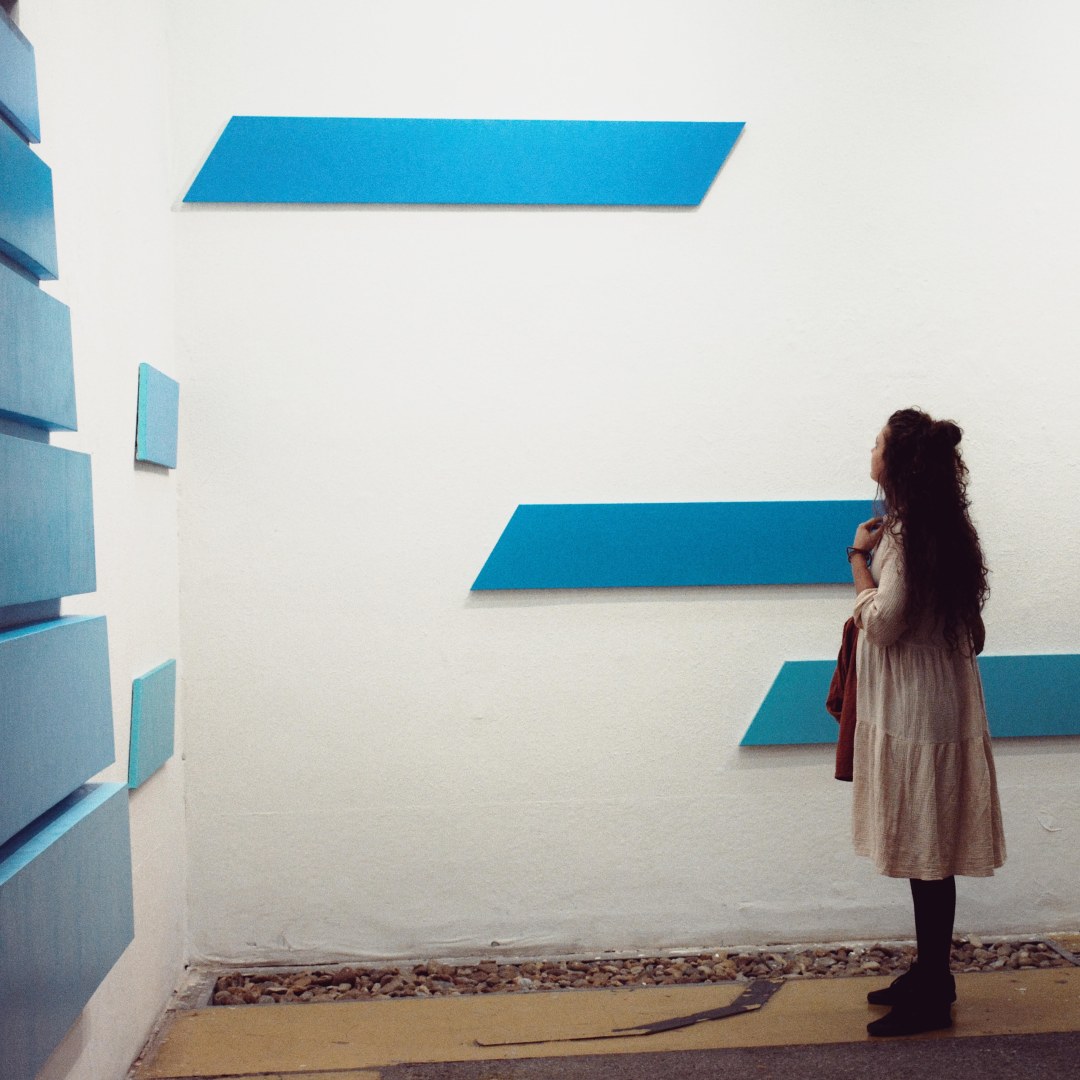
The exhibition stems from a simple question: what is the color that surrounds us most? For me, the answer is blue. Blue is simultaneously tied to the world around us—the sky, our waters—and to an inner, elusive experience. In these paintings, however, the goal is not to depict the sky or clouds, but rather to capture the shifting perception of how the surface begins to transform under our attention.
At first glance, the works appear as calm, almost monochrome surfaces. By dedicating time and attention, the color seems to expand, and the static image begins to move. The multiple, successive layers of glaze and the juxtaposition of brushstrokes create a kind of system. This system, however, does not serve to represent a specific form; instead, it explores the relationship between space and color within the pictorial plane.
In parallel, the relationship between the painting and space also becomes vital. I am intrigued by the point up to which a work can be considered a painting when the form of its support changes, while its material composition remains the same—built from wood, canvas, and oil paint. The question is not only what a painting is, but also where it begins and where it ends. At the exhibition, certain works can be interpreted as standalone pieces, yet in relation to each other and the exhibition space, they form a larger spatial construction. Thus, the space is not merely a support surface or a venue for presenting the works, but becomes part of the relationships between the pieces themselves.
How does the process between the artwork and the viewer become perceptible? Rather than conveying a predetermined meaning, I want to create an open, experiential space in which the viewer's own attention and movement shape the interpretation of the work. In this encounter, another, invisible artwork is born: the viewer's own experience, memory, and inner picture.
Opening:
Thursday, September 10, 2026, at 7 PM
Thursday, September 10, 2026, at 7 PM
Opening remarks by:
Laura Makra, art historian and curator
Laura Makra, art historian and curator
On view:
September 10 - 29, 2026
Opening hours:
Weekdays from 12 PM to 6 PM; on weekends, the exhibition can be viewed by prior appointment.
Weekdays from 12 PM to 6 PM; on weekends, the exhibition can be viewed by prior appointment.
Entrance:
Artus Studio / Gallery: 1 Sztregova Street, 1116 Budapest (factory grounds main gate, barrier).
Artus Studio / Gallery: 1 Sztregova Street, 1116 Budapest (factory grounds main gate, barrier).
Post
Story
Whatsapp